Leave Your Message

Who Are the Best Pull Latch Manufacturers in China?

Choosing the best Pull Latch manufacturer in China depends on more than price or a polished product photo. Buyers need hardware that fits the application, operates reliably, and arrives with clear specifications. A latch on a storage cabinet may face different demands from one used on a vehicle compartment or an industrial enclosure. Small details matter: mounting-hole spacing, catch alignment, material thickness, surface finish, and the feel of the handle during repeated use.

This guide explains how to compare Chinese manufacturers without treating a supplier listing as proof of quality. It considers product range, customization capability, stated materials, quality-control practices, sample availability, production lead times, and responsiveness to technical questions. Ask for dimensioned drawings and confirm load or cycle-test data when those values affect your design. Then inspect a sample under realistic conditions. Look for uneven plating, loose movement, sharp edges, or misaligned hardware. These checks cannot replace a factory audit, and a sample may not represent every production batch. Keep that in mind. The following overview helps readers assess potential suppliers, identify questions worth asking, and separate verifiable details from broad marketing claims. There is no universal winner; the right manufacturer is the one whose documented capabilities match your requirements and whose performance you can verify before placing a larger order.
Who Are the Best Pull Latch Manufacturers in China?

What Pull Latches Are and Where They Are Used

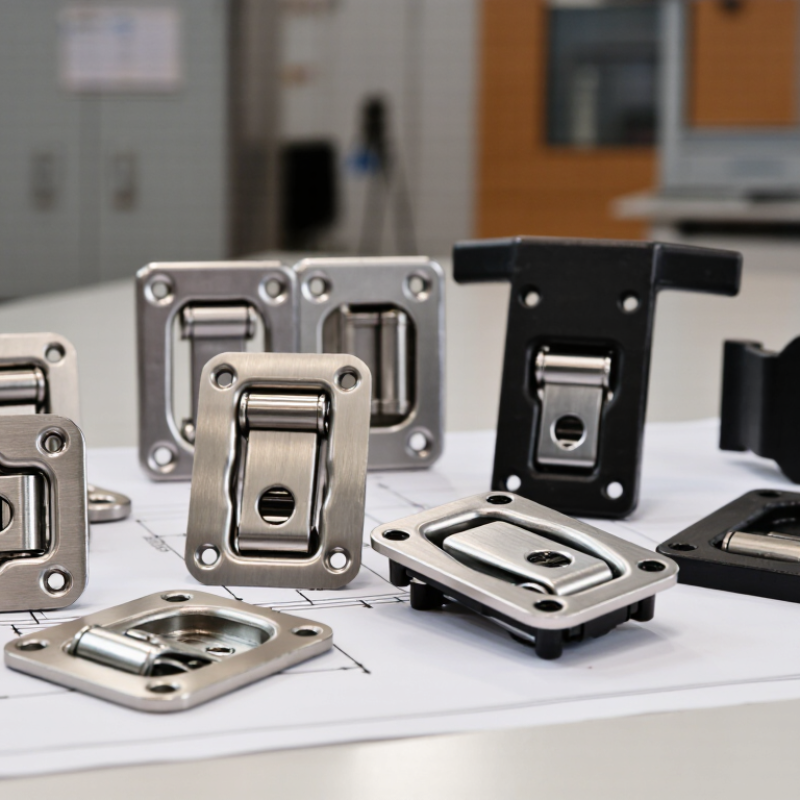
A pull latch is a compact mechanical fastener that keeps two surfaces closed until someone pulls its handle or tab. Many designs use a spring-loaded catch, while others rely on a simple sliding bolt. The exact action varies. A user pulls the handle to release the catch, then lets it return to secure the panel. This simple movement works well when a door needs a firm hold but frequent access.

Pull latches are used on equipment cabinets, storage chests, vehicle compartments, access panels, and cases for tools or instruments. In a workshop cabinet, for example, a recessed latch can reduce snagging while keeping the door shut during movement. On a vibrating enclosure, the latch must match the door’s weight and alignment; a loose strike plate can cause rattling or unreliable closure. Material, corrosion exposure, mounting space, and expected opening frequency all matter. A latch that feels smooth on a bench may bind after a panel flexes. That detail is easy to miss.

Tips: Measure the closed gap and mounting depth before choosing a latch. Check that the catch engages fully, and test it after installation. A little misalignment matters. Don’t force a sticky handle; inspect the fastener and surrounding panel first.

Who Are the Best Pull Latch Manufacturers in China? - What Pull Latches Are and Where They Are Used

Pull Latch Type How It Works Typical Applications Common Materials Key Selection Considerations
Over-center draw latch A lever moves past a center point to pull a keeper and hold two surfaces together. Equipment cases, access panels, storage boxes, and light-duty enclosures. Plated steel, stainless steel, and zinc alloy components. Check the required pull-up distance, keeper position, operating clearance, and expected load.
Adjustable draw latch A threaded hook or adjustable link changes the distance between the latch body and keeper. Boxes, cabinets, machine covers, and assemblies where alignment may vary. Steel or stainless steel, often with plated or passivated finishes. Confirm the adjustment range, mounting layout, and whether the latch can be secured against accidental opening.
Compression draw latch Closing the latch draws the panel against a seal or gasket, creating compression at the joint. Electrical enclosures, instrument cabinets, and panels that need a tight closure. Stainless steel, plated steel, and corrosion-resistant hardware. Match the latch’s compression range to the gasket and panel geometry; use a suitable seal for the intended environment.
Recessed pull latch The grip or handle sits within a recessed cup or housing; some versions include a separate latching mechanism. Flight and transport cases, sliding panels, cabinets, and surfaces where a projecting handle is undesirable. Steel, stainless steel, aluminum, or molded polymers, depending on design. Check cutout dimensions, available installation depth, edge clearance, and whether the model actually provides a latch.
Spring-loaded pull latch A spring-loaded catch or plunger engages a strike and retracts when the release is operated. Equipment doors, access covers, and cabinets requiring quick, repeatable opening. Stainless steel, plated steel, or engineered plastics for selected components. Review the strike alignment, release direction, spring action, and suitability for vibration or frequent cycling.
Rotary draw latch A rotating claw or cam engages a striker and pulls the panel into its closed position. Vehicle compartments, machinery doors, and industrial access panels. Steel or stainless steel, with material and finish selected for the operating environment. Confirm striker compatibility, mounting space, release method, and whether a secondary safety feature is needed.

Pull latches are closure hardware used to draw, retain, or release panels and doors. Product names and designs vary, so verify dimensions, load ratings, materials, and environmental suitability against the manufacturer’s technical documentation before specifying a latch.

How to Evaluate Pull Latch Manufacturers in China

When evaluating pull latch manufacturers in China, look beyond polished catalogs and low unit prices. Request dimensioned drawings, material grades, finish specifications, and stated load limits before comparing quotations. A latch for a service hatch may need different spring force and travel than one fitted to a storage case. Small details matter. Ask for samples made through the same process planned for your order. Check alignment, sharp edges, handle return, and whether the screws sit flush on your actual panel. If testing is offered, confirm the cycle count, applied load, and pass criteria. A vague “tested” claim proves little.

A capable manufacturer should explain its checks for incoming materials, forming accuracy, and finished-latch operation. Ask for inspection records from recent production, not just a blank quality form. For custom dimensions, clarify tooling charges, sample approval steps, and how revisions are documented. It is tempting to trust a fast reply as proof of strong support; it is not. Ask how the supplier handles a rejected sample or a dimensional mismatch, and note whether the answer includes a clear corrective process. Production capacity and lead times should be stated in writing, with assumptions about order quantity. A small pilot order can reveal gaps that a sales call misses. Even then, one sample cannot predict every batch.

Leading Pull Latch Manufacturers in China

Leading Pull Latch Manufacturers in China

Leading pull latch manufacturers in China stand out through consistent engineering, clear documentation, and reliable production—not catalog size alone. Buyers should compare latch material, finish, rated load, mounting dimensions, and cycle-test results. Ask for drawings and sample units, then check whether the latch sits flush against your actual panel. A few millimeters can matter. Fit matters most.

China’s manufacturing base remains substantial: the National Bureau of Statistics reported that manufacturing value added grew 5.0% in 2023. This broad measure does not track pull latches specifically, but it offers useful context for evaluating the country’s industrial supply chain. When assessing suppliers, request traceable inspection records and details on material and coating checks. A polished sample is helpful, but it cannot prove that every production batch will match. That gap deserves attention.

Tips: Test the latch under real installation conditions. Check alignment, opening force, vibration resistance, and finish after repeated use. Ask how defects are recorded and handled; vague answers are a warning sign.

Comparing Product Quality, Customization, and Service

Choosing a pull-latch manufacturer in China means checking evidence, not just polished catalog photos. Ask for material grades, load ratings, dimensional tolerances, and batch inspection records. Test samples with the intended finish and mounting hardware; a latch that feels smooth on a desk may bind after installation. For metal parts, ask whether corrosion testing uses a stated method, such as ISO 9227 salt-spray testing. Match test duration to the product’s real environment.

Customization should cover more than dimensions. Discuss handle clearance, mounting-hole positions, spring force, finish, packaging, and minimum order quantities before approving drawings. Deloitte’s 2024 Smart Manufacturing Survey found that 86% of surveyed manufacturers expect smart manufacturing to drive competitiveness within five years. The finding is not specific to latches, but it highlights the value of traceability. Ask suppliers to connect inspection records to production batches and drawing revisions.

Service is easiest to judge through specifics: sample lead time, engineering response time, spare-part availability, and a clear process for handling defects. Request a written schedule and one technical contact. Small details matter. A sample cannot reveal everything, and a low quoted price may leave costly questions unanswered about tooling or reorders. Verify those details before production begins.

Key Factors in Selecting a Pull Latch Supplier

When selecting a pull latch supplier, look beyond the product photo. Confirm the latch’s dimensions, mounting-hole spacing, load capacity, and operating clearance. These details affect whether it fits your panel and opens smoothly. Ask how the supplier checks consistency between production batches. Clear inspection records are more useful than broad quality claims.

Request a sample before placing a large order. Fit it to a panel with the same thickness as your intended application. Open and close it repeatedly, and check for sticking, loose movement, or sharp edges. Test it under realistic conditions. A latch that feels firm in a showroom may behave differently after vibration or frequent use.

Material and finish should suit the installation environment. For damp areas, ask about corrosion resistance and how the finish is tested. Also review lead times, minimum order quantities, packaging, and replacement-part availability. Communication matters. A supplier should answer technical questions directly and flag limitations early. Price still counts, but the cheapest option may require more adjustments later. I would not assume every sample represents bulk production; request written specifications and confirm how they will be maintained.